
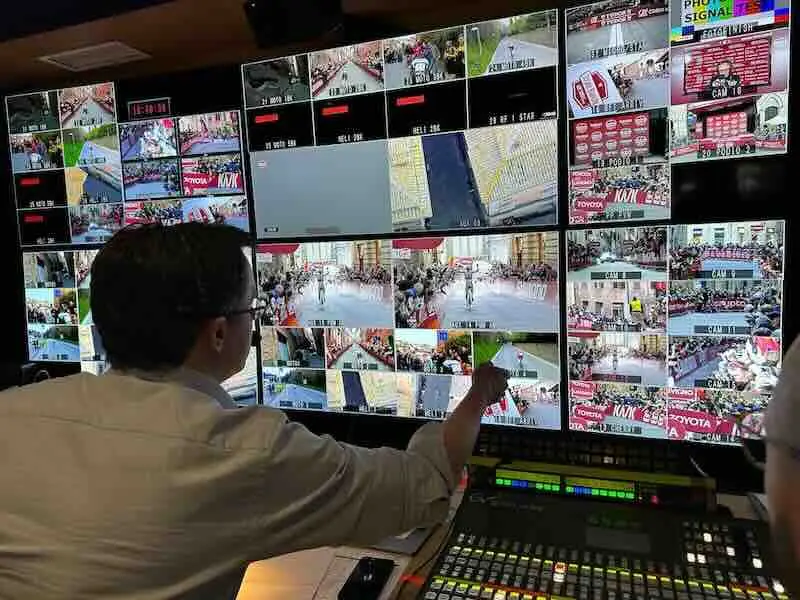
 Once again, for the opening of the World Tour races, organiser RCS Sport worked closely with EMG Italy / Gravity Media, which managed the entire production, coordinating and implementing all technical decisions, providing personnel and equipment.
The Tirreno-Adriatico
As part of its ongoing technical and qualitative improvements, which are characteristic of EMG Italy / Gravity Media, the time trial in Lido di Camaiore, within the Tirreno-Adriatico, featured IP and simulcast transmissions.
The satellite transmission of individual multiplexed signals allowed for the reception of not just a pre-packaged product with camera footage from the start and intermediate points, but all individual feeds within the OB van and the video mixer at the finish line.
This approach enabled the director and vision mixer operator to switch, view, communicate with crews, and manage tally and camera controls independently, as if they were directly connected to the mobile unit, despite being several kilometres away.
Every day, for seven days, the race was produced with four motorbikes equipped with dual RF and 4G transmission, a helicopter, and an aeroplane.
 The Milano-Torino
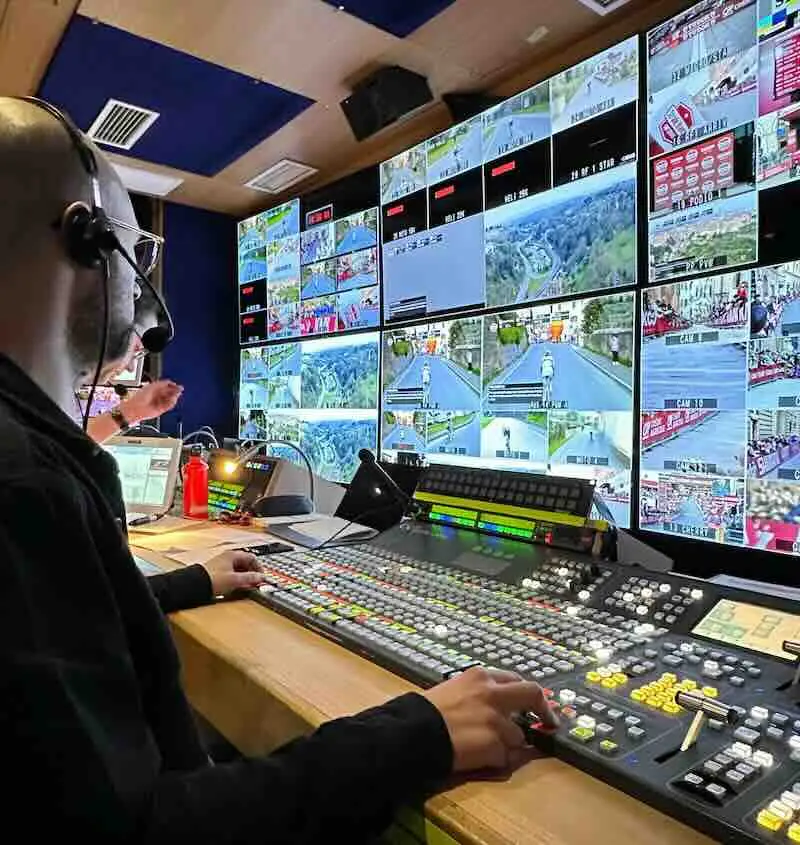
The Milano-Torino was produced using the "standard B" configuration, a slightly lower setup, which posed challenges in accessing Superga, as the roads leading to the location are particularly difficult for larger production vehicles. In this scenario, three motorbikes, a helicopter, and 13 ground cameras were used.
Strade Bianche
Among the races held so far, Strade Bianche was managed with a different configuration than usual, serving as the first operational test for the setup that will be used in the Giro d’Italia.
In the next edition, one of the Giro stages will take place in the renowned Piazza del Campo in Siena.
The TV compound, which until last year was dedicated to Strade Bianche, was no longer deemed suitable for the upcoming event and was therefore moved from an area adjacent to the square to a new location near Siena’s stadium.
This relocation required the installation of a remote fibre optic connection between the stadium and Piazza del Campo, extending to the surrounding streets where cameras are positioned, including those in the narrow alleyways up to 800 metres from the square.
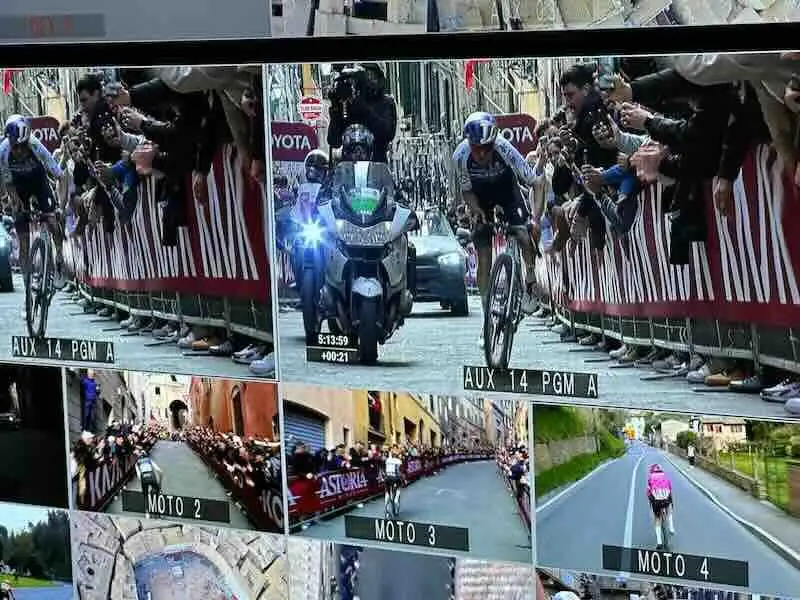 The partially fixed fibre connection was set up by RCS and consists of 96 single-mode fibres.
These interface with the fixed cabling of Piazza del Campo, implemented last year by the Consorzio del Palio, and with the entire EMG Italy / Gravity Media setup within the TV compound.
For event coverage, 13 ground cameras, five motorbikes transmitting five AV signals via RF and five via 4G, two helicopters, and a relay aeroplane were used.
The Milano-Sanremo
One of the most significant innovations in cycling production this year was the Milano-Sanremo.
For the first time in cycling television production, the event featured simultaneous coverage of two races: the men’s competition, with complete coverage from the start in Pavia to the finish in Sanremo, and the women’s race, Sanremo Woman, which was broadcast live for the final two hours, starting from Genoa.
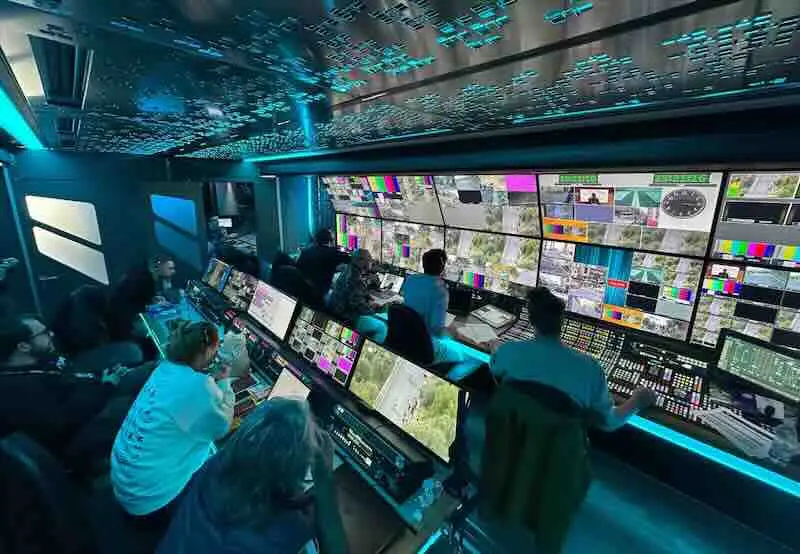 The main challenge was deploying a unit capable of managing a full dual production, with double control rooms, equipment, personnel, dedicated EVS systems, and the necessity to share some resources, such as the finish line cameras and post-race coverage.
The requirement to provide two separate feeds for broadcasting and commentary significantly complicated communication management during the dual production.
For the first part of the men’s race, up to Passo del Turchino, four motorbikes and a helicopter were used, though the helicopter had to abort its route due to adverse weather conditions.
The women’s race employed three motorbikes and a second helicopter, which, along with a motorbike, moved after the women’s race to follow the final two hours of the men’s event.
This setup necessitated two relay planes to ensure uninterrupted transmission: the first followed the early stages of the men’s race, while the second took off later, covering the women’s race until the finish before returning to Savona to reconnect with the men’s race motorbike signals, replacing the first aircraft when it reached its operational limit.
This operation required two identical aircraft, equipped with the same onboard systems, ensuring seamless dual production and aircraft switching without any transmission interruptions, presenting significant technical challenges in operational management.
“All worked perfectly,” commented Davide Furlan, Outdoor Production Director of EMG Italy / Gravity Media, “despite particularly challenging weather conditions in the first part of the race, including rain, snow, and turbulence at altitude, the production quality was outstanding.
This was evident both in the captured images and in the total absence of signal dropouts.
Viewers on RAI and Eurosport noted that this edition was one of the most visually impressive of the last 20 years, with high ratings and global visibility.”
 International Cooperation
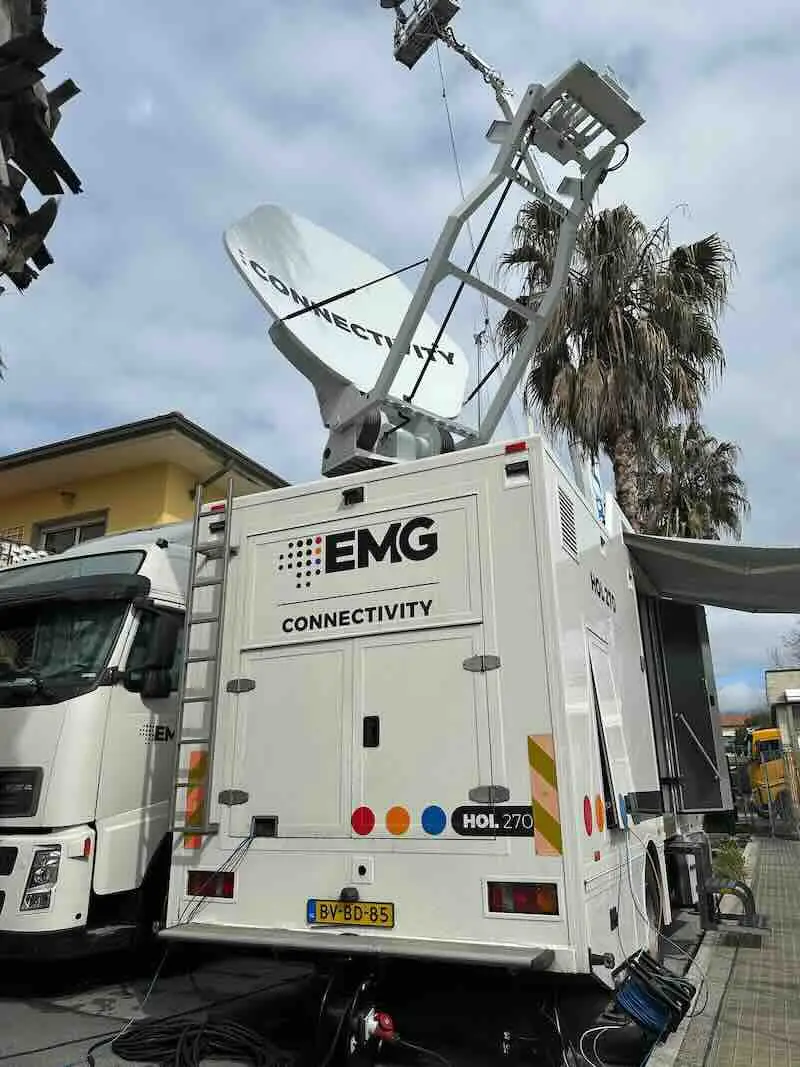
For connectivity, the international EMG Connectivity department was involved, as is the case for the Tour de France and the Giro d’Italia.
For satellite coverage, three EMG Netherlands SNG stations were engaged: one located beyond Passo del Turchino, towards the Po Valley, and a second at the TV compound in Sanremo.
At these locations, two EMG France reception OB vans, equipped with auto-tracking antennas, received signals from the two aircraft, which were encapsulated in ASI and then combined to create the two international feeds for the different races.
An additional complexity was the use of a live drone, which followed the entire descent of the Poggio, one of the most iconic and decisive segments of the race.
This section represents the final elevation obstacle before the finish line—a technical and winding descent of approximately 3.2 km with an average gradient of 4%, leading rapidly to the final straight on Via Roma in Sanremo.
The drone had to maintain a position between two and three and a half metres above the cyclists, posing significant challenges and risks for aerial filming. For this occasion, the Italian FPV drone champion was involved.
To manage the drone’s signal, a dedicated reception zone was set up next to a satellite station for the feed.
Additionally, all communications were handled via an app (the same used in remote football production), allowing the drone pilot and camera operator to stay connected via intercom with the main gallery for director instructions.
Also noteworthy is the extensive work by Boost Graphics, which deployed three units to provide all live graphics in English and Italian (with the Italian version used by RAI, which integrated it on-site).
Additionally, Pixel Tracking was implemented, enriching helicopter footage with live information and enabling the identification of key riders in the peloton and breakaways. This was managed across two simultaneous live productions, requiring four active graphic lines plus backups.
Microplus, long-time partner of EMG Italy / Gravity Media, also played a key role by providing timing data essential for graphics and for the official race times required by the UCI.
 The Major Challenge
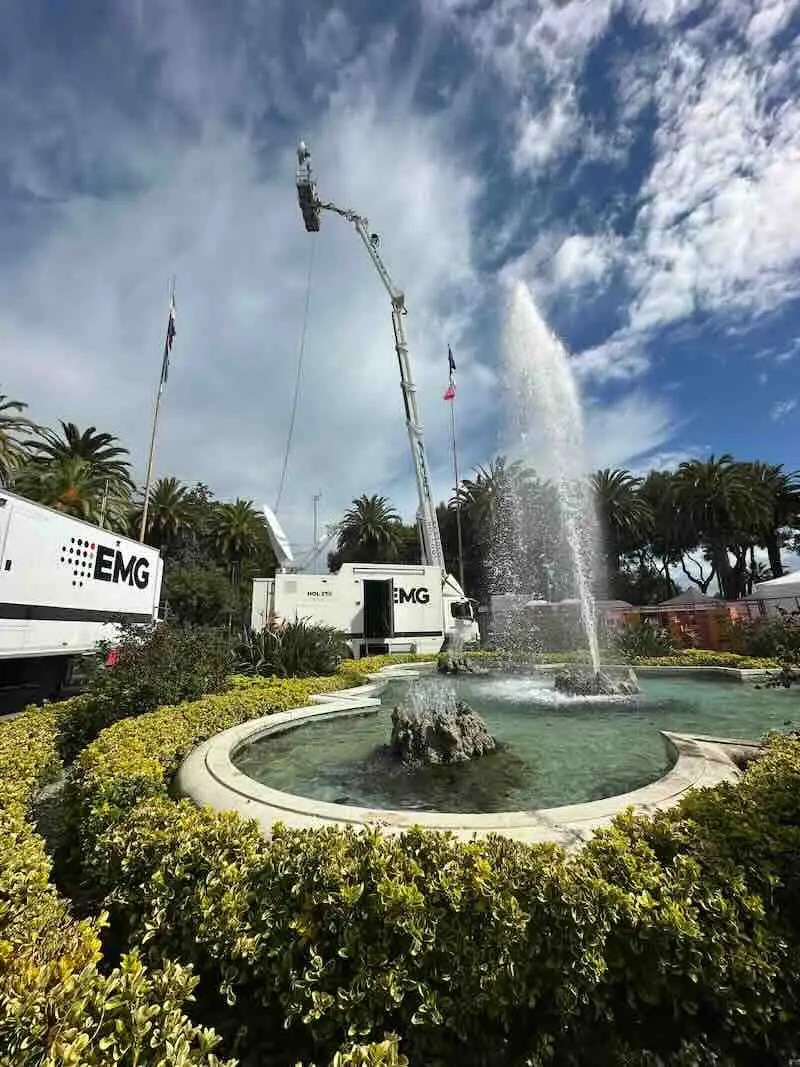
Davide Furlan concluded: “This edition of Sanremo saw RCS push us well beyond the already high standards of major live cycling productions. When Andrea Basso, Head of Broadcast Production at RCS, first shared the vision for the dual race, I must admit I had some concerns, but challenges drive growth, and having the colleagues I do gave me confidence.
From a technical standpoint, I consider this one of the most complex live RF cycling productions ever managed, not only due to the significance of the race, with millions of passionate viewers, but also because of the course complexity and, above all, the simultaneous live dual production.”
###
Synopsis:
EMG Italy / Gravity Media once again worked closely with RCS Sport to manage the technical production of World Tour races. The collaboration included IP and simulcast transmissions for events like the Tirreno-Adriatico, Milano-Torino, and Milano-Sanremo. Advanced technology, such as dual RF and 4G motorbikes, helicopters, and relay planes, ensured seamless coverage of challenging race routes and provided exceptional viewer experiences. Innovative solutions for simultaneous coverage, remote fiber connections, and drone filming were integral to these broadcasts, making them some of the most complex and visually impressive in recent years.
Hashtags:
#EMGItaly, #WorldTour, #TirrenoAdriatico, #MilanoSanremo, #cyclingproduction, #broadcasting, #livebroadcast, #RFtechnology, #sportsbroadcast, #remoteproduction
© 2025 EMG /Gravity Media – Presspool PressOffice RobertoLandini
