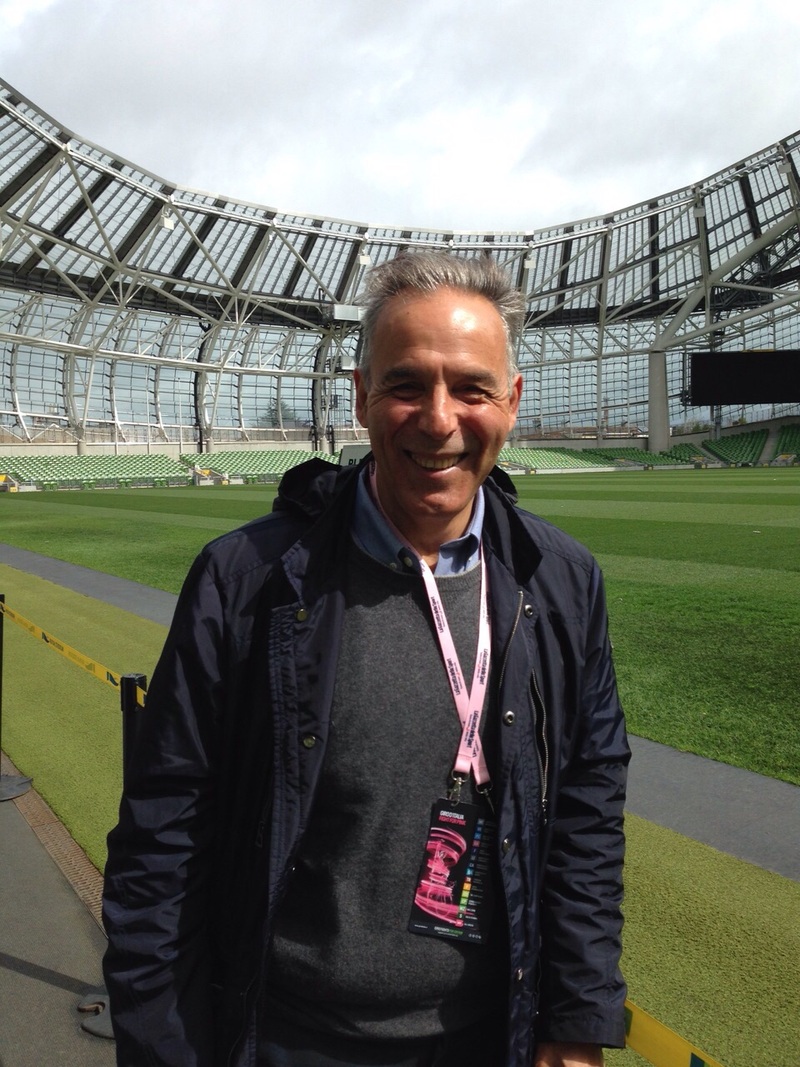
One year has passed since we last described Giro d'Italia from a technical point of view, and it is time to talk again to Mr Enrico Motta who is Tv Tech Manager of such production which follows the most important bicycle race in Italy and is approaching its final lap for 2012 edition. Motta is Chief Project for “RAI Produzione TV Grandi Eventi” which is a RAI sister company dealing all major events in sports and not only, as its name suggests. 17 May 2012.
From a technical point of view, several major changes were started the previous year and now have reached their climax, because all RAI compound dedicated to Giro d'Italia is now throughly cabled with optical fibres: Enrico Motta proudly states: “no more copper cables with tons of wires scattered everywhere, but jus simple twist of fibre optical cables carrying everything in digital formats, audio, video, data, communications, etc.”
The other important leap forward is that even live and moving tv shooting from this year on is made completely in the digital domain, therefore, everything, from motor cycles cameras to the helicopters all images fir the first time are shot and delivered in the numeric format up to on air transmission.
And that's not all, since for the first time at this 2012 edition of Giro d'Italia the main control room receives contemporarily six digital signals, while in the past only four analogical signals were delivered and were routed one at the time directly from the moving media, that is from the helicopters carrying proper equipments.
Today all six signals travel digitally and reach the control room at the same time, contemporarily.
Motta intervenes: “The technical leap forward as far as engineering and final on air quality is definitely huge for us. Besides, having for the first time the support of digital quality, at RAI Produzione TV Grandi Eventi we are testing high definition shooting also for Giro d'Italia, even if for internal use by now. These HD signals are delivered at the same time as SD ones.”
As positively experienced also in the past, eight motorcycleTV-cameras, two shooting helicopters, two radio link helicopters and a whole modular control room are engaged in every step of the race.
During the night all ob-vans move to the next lap of the race and settle near the finishing line to be ready before the following lap of the race starts.
Actually the Giro requires a perfect organization since the complexity and variety of every lap; so there is a personnel turnover, while all tech facilities are the same.
Enrico Motta underlines: “Our tech facilities are exactly what is needed, not even one more or less than necessary, though everything is redundant, the number of tech equipments has remained the same as last year. The only big difference is that now all signals are digital.”
All equipments chosen for such complex “corpus” are Riedle for fiber optics video matrix, Optocore are used for all audio signals distribution, optical fibers are by Telecast, chosen on behalf the job they have to fulfill, and according to functional choices “to accomplish what has to be done: we have simply chosen what we needed.”
Enrico Motta is in charge of project and system engineering for Giro d'Italia and he is helped in his job by the engineering department of RAI called “Ingegneria di Produzione” based on a team of professionals headed by Ing. Ubaldo Toni.